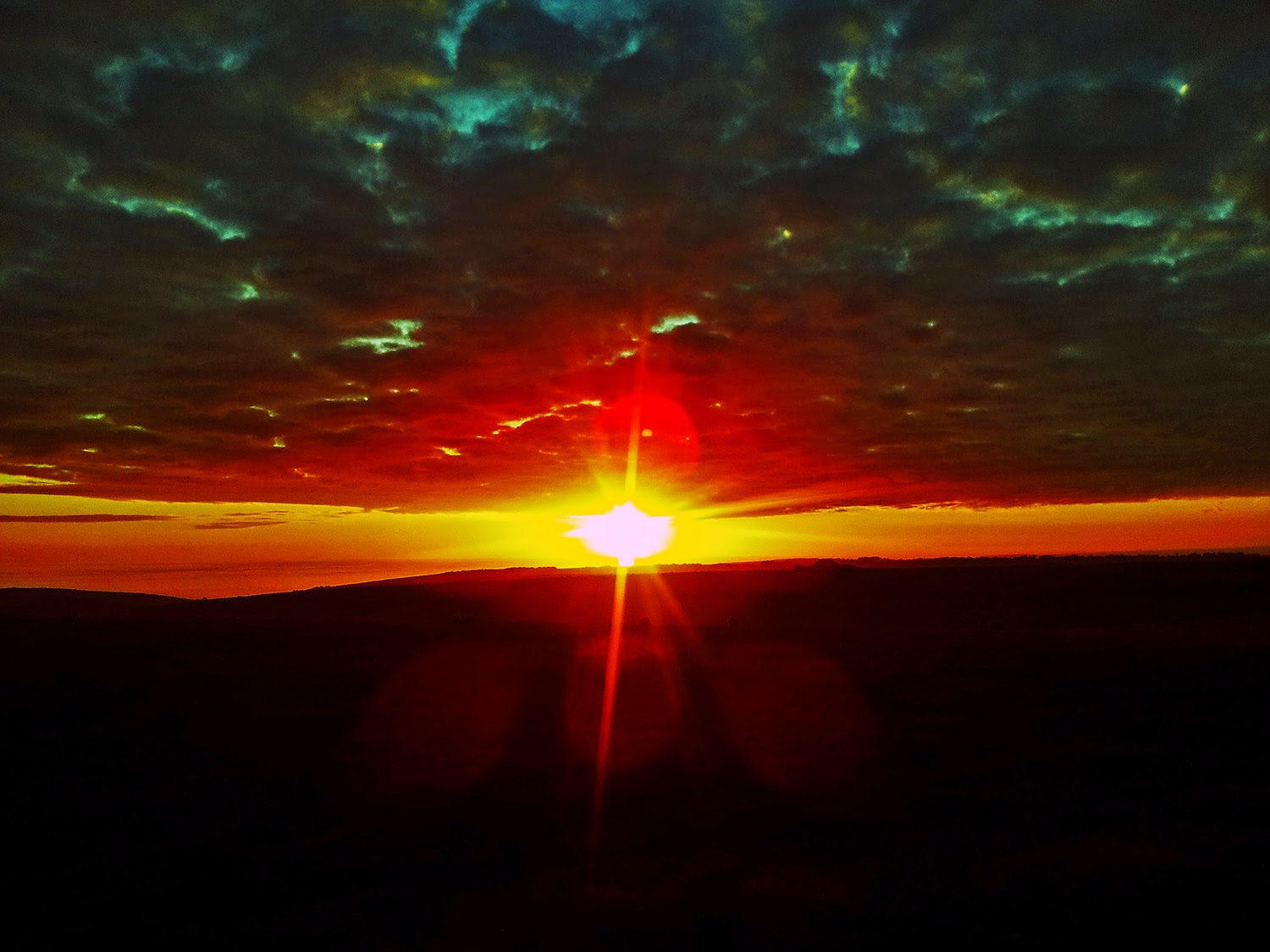
Fragments of "The Testament of Beauty" by the British Poet Robert Seymour Bridges:
'Twas at that hour of beauty when the setting sun squandereth his cloudy bed with rosy hues, to flood his lov'd works as in turn he biddeth them Good-night... ...'Twas at sunset that I, fleeing to hide my soul in refuge of beauty from a mortal distress, walk'd alone with the Muse in her garden of thought, discoursing at liberty with the mazy dreams that came wavering pertinaciously about me...
Butchershole provides access to the eastern edge of Friston Forest.
Friston Forest is owned by South East Water and managed by the Forestry Commission on a 200 year lease. The forest covers more than 800 hectares of land within the South Downs National Park. Most of the forest was planted with Beech in the 1950s, in places with conifers to help young broadleaf trees to develop. Gradually many of the conifers have been removed to leave large areas of beech. Because many of the trees were planted over a very short timeframe, the Forestry Commission is concentrating on diversifying the forest through thinning, small fellings, natural regeneration and planting.
Travelling up and down the railways and motorways of the UK
in recent weeks, it seems like the surrounding fields are yellower than
ever.
The bright dandelion-yellow flowers of oilseed rape have been
a familiar sight across farmland in spring across the country for
years.
But now experts say farmers are growing more than ever before.
The boom is being driven by rocketing prices as it becomes
more desirable for food, and other producers in Europe suffer the
effects of bad weather.
Dr Fiona Burnett, a plant
pathologist at the Scottish Agricultural College, says rapeseed oil has
historically fulfilled a useful role as a "break crop" in farm rotation -
to suppress weeds and improve soil quality - for cereal crops such as
wheat and barley.
But whereas in the past the crop has been largely functional -
and has not made farmers much money - in recent years it has become
hugely profitable, she says.
The Long Man of Wilmington: the mysterious guardian of the South Downs,
who has baffled archaeologists and historians for hundreds of years. http://sussexpast.co.uk/properties-to-discover/the-long-man
Until recently, it was believed that the earliest record of Europe’s
largest representation of the human form was a drawing dated to 1766.
The artist was William Burrell, and the drawing was made during his
visit to Wilmington Priory, which lies under the steep slopes of
Windover Hill, home to the 235 feet high Wilmington Giant. In 1993,
however, a new drawing of the Long Man was discovered, made by the
surveyor John Rowley in 1710.
The new drawing has confirmed some theories and dispelled others. It
suggests that the original figure was a shadow or indentation in the
grass rather than a solid line; there were facial features that are no
longer visible; the staffs being held were not a rake and a scythe as
once described and the head was once a distinctive helmet shape, giving
credence to the idea of the figure as a helmeted war-god.
Until the 19th century the Long Man was only visible in certain light
conditions and after a light fall of snow, but in 1874 it was marked
out in yellow bricks. It is claimed that during this restoration the
feet were incorrectly positioned but, despite popular local legend,
there is no evidence, historical or archaeological, to suggest that
prudish Victorians robbed the Giant of his manhood!
In 1925, the site of the Long Man was given to the Sussex
Archaeological Trust (now the Sussex Archaeological Society) by the Duke
of Devonshire. During World War II, the figure was painted green to
prevent enemy aviators using it as a landmark. In 1969, further
restoration took place and the bricks were replaced with pre-cast
concrete blocks that are now regularly painted to keep the Long Man
visible from many miles away. The terracettes, horizontal ripples in the
turf, change constantly as the soil is rolled downhill by weathering
and animal activity. Overnight, between 17 June and 18 June 2010 a giant phallus was painted on the Long Man rivalling that of the Cerne Abbas Giant.
The lack of firm historical evidence still leaves many theories
abounding about his history. Many Sussex people are convinced that he is
prehistoric, other believe that he is the work of an artistic monk from
the nearby Priory between the 11th and 15th centuries. Roman coins
bearing a similar figure suggest that he belonged to the 4th century AD
and there may be plausible parallels with a helmeted figure found on
Anglo-Saxon ornaments.
Fertility symbol? Ancient Warrior? Early 18th century folly? We may
never know. Until such time as new evidence is unearthed, we shall have
to content ourselves with the words of the Rev A A Evans who said, “The
Giant keeps his secret and from his hillside flings out a perpetual
challenge.”
It is of good ale to you I'll sing
And to good ale I'll always cling,
I like my mug filled to the brim
And I'll drink all you'd like to bring,
O, good ale, thou art my darling,
Thou art my joy both night and morning.
It is you that helps me with my work
And from a task I'll never shirk
While I can get a good home-brew,
And better than one pint I like two
O, good ale, etc.
I love you in the early morn
I love you in daylight dark or dawn,
And when I'm weary, worn or spent
I turn the tap and ease the vent,
O, good ale, etc.
It's you that makes my friends my foes,
It's you that makes me wear old clothes,
But since you come so near my nose
It's up you comes and down you goes,
O, good ale, etc.
If all my friends from Adam's race
Were to meet me here all in this place,
I could part from all without one tear
Before I'd part from my good beer,
O, good ale, etc.
And if my wife did me despise
How soon I'd give her two black eyes,
But if she loved me like I love thee
What a happy couple we should be,
O, good ale, etc.
You have caused me debts and I've often swore
That I never would drink strong ale no more,
But you for all that I forgive
And I'll drink strong ale just as long as I live,
O, good ale, etc.
The Belle Tout Lighthouse was built in 1832 and decommissioned in 1902. It has been a
tea-shop, a home ; part-destroyed during the second
world war, was lovingly rebuilt in the 50's. In 1986, the BBC purchased the lease to Belle Tout for the filming of mini-series The Life and Loves of a She-Devil and a year later it featured in the James Bond film The living Daylights.
By 1999 the erosion of the cliffs was threatening the foundations of the
building and drastic steps had to be taken to stop it from falling into
the sea. On 17 March 1999 in a remarkable feat of engineering work the
Belle Tout was moved 17 metres (56 ft) away from the cliff face.
The 850-ton lighthouse was moved using a pioneering system of hydraulic
jacks which pushed the building along four steel-topped concrete beams
that were constantly lubricated with grease. The site should now be safe
for many years and has been designed to enable further moves as and
when they are required.
It is currently a luxury hotel.